

English
Padel club profitability: realistic ROI, payback, revenue per court and operating costs. Analysis for investors. Request a quote tailored to your project.
Opening a padel club is one of the most attractive investments in the sports sector, but also one of the most misunderstood. The profitability of a padel club is not decided by the number of courts alone: it depends on occupancy, price per hour, fixed costs and, above all, the quality of the court, which determines how long the business will run without major repairs. Here we explain how real ROI is calculated and what makes a club make money —or not— always with indicative figures that you should later ground in a study of your own project.
At Padel Hispania we work every year with private investors, sports clubs, hotels, public administrations and developers who want to build new padel projects. One of the first questions they all ask us is the same: is a padel club really profitable? The answer depends on many factors, but experience shows that good planning from the outset makes the difference between a profitable project and one that piles up problems from the very first years.
A padel club is, essentially, a court-hour rental business. Revenue depends on three variables that are worth being clear about from the start:
On top of this base revenue come the complementary sources —lessons, tournaments, café, shop, memberships— which in practice make the difference between a club that survives and one that is profitable.
Even before calculating profitability, it is important to define the type of club you want to create. An urban four-court club does not generate the same revenue as a sports complex with a school, catering and events. Designing the project correctly from the start avoids unnecessary investment and makes it possible to optimise the expected return.
The simplified formula to estimate rental income is:
Revenue = no. of courts × available hours/day × % occupancy × price/hour
From our experience at Padel Hispania, one of the most common mistakes when planning a padel club is overestimating the occupancy that will be achieved during the first months of activity. Drawing up realistic forecasts makes it possible to size the investment correctly, plan cash flow better and set sustainable growth targets from the start.
The key is not to fool yourself about occupancy. Not all hours are worth the same: evening and weekend slots fill up, but weekday mornings are much harder to sell. That is why a club is not sustained by its average occupancy, but by its ability to fill the highest-demand slots —and to bill outside them too, with lessons, leagues and a padel school.
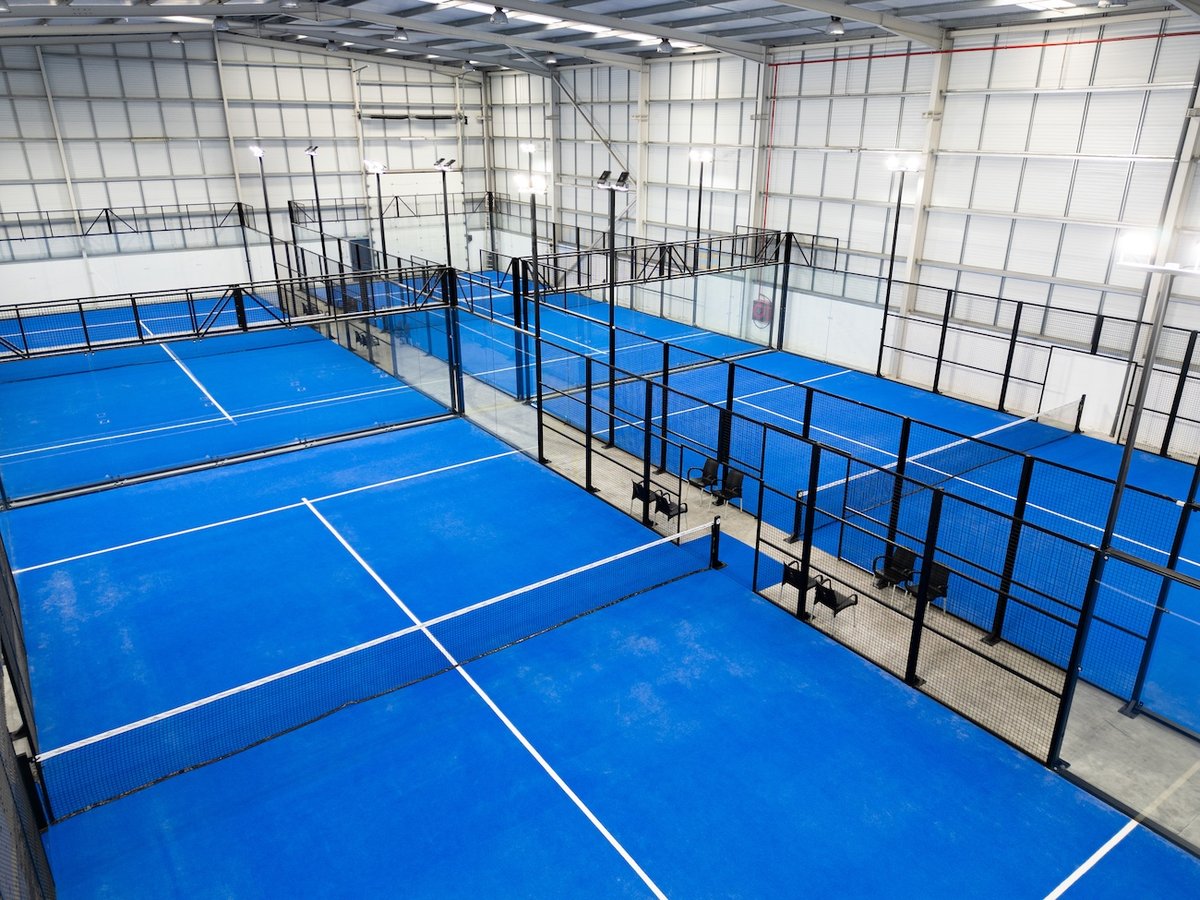
Roofing is decisive here: a club that cannot operate in rain or extreme heat loses days of billing precisely when demand is highest. Being able to play all year round and at any time is, in practice, one of the decisions that weighs most heavily on revenue.
In many projects, installing a roof should not be seen merely as an additional cost; at Padel Hispania we see it as an investment that keeps the club running all year round and considerably improves court usage. Analysing when to add roofing is part of the project's financial planning.
Revenue is only half of the equation. Real profitability depends on controlling fixed costs, which exist whether people play or not:
It is also worth considering the costs that do not always appear in the initial budgets, such as premature component replacements, downtime due to breakdowns or extraordinary maintenance. A higher-quality installation, like the one we offer at Padel Hispania, tends to reduce these costs significantly over the life of the club.
The practical rule we already saw when talking about investment also applies to operations: more courts spread fixed costs better, provided local demand justifies filling them.
ROI and payback: when you recover the investment
Payback (the recovery period) is the question every investor asks, and the honest answer is: it depends. The return period is built from occupancy, price per hour, complementary revenue sources and the initial investment the project has required.
A well-located and well-managed club, with roofing to operate all year round, recovers the investment within a reasonable medium-term horizon. A poorly sized one —too few courts for its demand, no roofing, a low-quality court that starts causing problems— can stretch that period indefinitely. That is why any ROI figure given without knowing the project is only indicative: the serious approach is to carry out a prior study of demand and investment before deciding.
For this reason, at Padel Hispania we always recommend carrying out a prior study of the project before making decisions about the number of courts, the type of installation or the investment in roofing. A sound initial approach usually has a far greater impact on profitability than small differences in construction cost.
The decisions that most affect profitability
What makes a club unprofitable
The most expensive mistake is almost always the same: skimping on the court. A low-quality court generates constant maintenance, service stoppages and a poor experience that translates into customers who do not come back. In a business that lives on recurring occupancy, that is lethal.
In practice, an initial price difference can end up being irrelevant if the court causes incidents, requires frequent repairs or gives the player a poor experience. That is why the correct analysis should not be based on the purchase price alone, but on the total cost of the court over its entire useful life: how much you will spend keeping it running and how many billable hours you will lose if it fails.
At Padel Hispania, over the years, we have seen projects that initially looked cheaper end up needing major repairs much sooner than expected. That is why, beyond the purchase price, it is advisable to assess aspects such as the quality of the materials, the manufacturing process, the installer's experience and the after-sales service.
At Padel Hispania we manufacture and install padel courts for clubs, hotels, municipal centres and investors who want to develop a profitable and durable business. All our courts are certified by the Spanish Padel Federation, which guarantees the highest quality and playing experience, and fewer incidents over the life of the club.
Our work does not stop at delivering a court: we support the client in choosing the most suitable model, configuring the materials and planning the project, so that the investment is ready to generate income from day one. Each quote is studied individually, because final profitability depends on the number of courts, the location, the type of installation and the business model.
Is a padel club profitable?
It can be, and very much so, if the project is well sized. Profitability depends on location, occupancy, price per hour, fixed costs and the quality of the installation. There is no universal ROI: the right approach is to estimate it based on a study of the specific project.
How long does it take to recover the investment?
It depends on occupancy, price per hour and complementary revenue sources. A well-located and well-managed club, with roofing to operate all year round, recovers the investment within a reasonable medium-term horizon.
What occupancy does a club need to be profitable?
There is no magic number: what matters is filling the highest-demand slots (evenings and weekends) and complementing them with lessons, school and tournaments. A prior study of local demand is essential.
How does roofing improve profitability?
It allows you to operate in rain, cold or extreme heat, meaning you do not lose days of billing. It is one of the investments that pays off soonest in most projects.
Does court quality affect profitability?
Directly. A reliable court avoids service stoppages and repairs, and offers an experience that builds loyalty. The correct analysis is based on the total cost of the court over its entire useful life, not just on the purchase price.
Request an analysis of your project
Do you want to know whether your club would be profitable? Tell us how many courts you are planning, where it will be located and what type of installation you need. At Padel Hispania we will prepare a personalised assessment to help you estimate the investment, the occupancy required and the payback period with a clear view of profitability.
Leave us your details and we will contact you shortly, with the aim of starting to work from the very first moment to build the padel court you need.
Submitting form. Please wait.
Error sending the form
Please try again.
Form submitted successfully!
We will contact you as soon as possible.